
The Araripe Manakin, Keeper Of The Spring Waters
Photography by Gerrit Vyn;
story by Gustave Axelson
To see one of the most exciting ornithological finds of the past 20 years, I had to stand in line. In front of me stood a man in a tank-top and flip-flops. Behind me were two women with beach towels slung over their shoulders. Beside them were giddy children hopping up and down, about to burst with anticipation.
I was giddy, too. But not for the same reason. When the water park opened for business at 10 a.m., the line filed through the turnstile and down the walkway. At a little thatched hut selling flippers and swim goggles, the flip-flop crowd funneled left, toward the waterslides. I bore right onto a clean, paver-stone pathway enshrouded by jungle trees.
Almost immediately, a friendly song chimed from the trees: too-too, toot-toodle-oo! My companion, Brazilian biologist Alberto Campos, whispered one word: Soldadinho!
Soldadinho do Araripe is the Brazilian common name for the Araripe Manakin. First described in a scientific journal in 1998, the soldadinho (or “little soldier”) quickly made the most-wanted list for globe-trotting birders touring Brazil. As an isolated endemic, it’s a rare get for any life list—a manakin that in all the world lives only in a 30-mile-long forested stretch in the northeastern state of Ceara, along the eastern side of the Araripe plateau. The bird’s true appeal, though, is not its rarity, but its striking beauty.

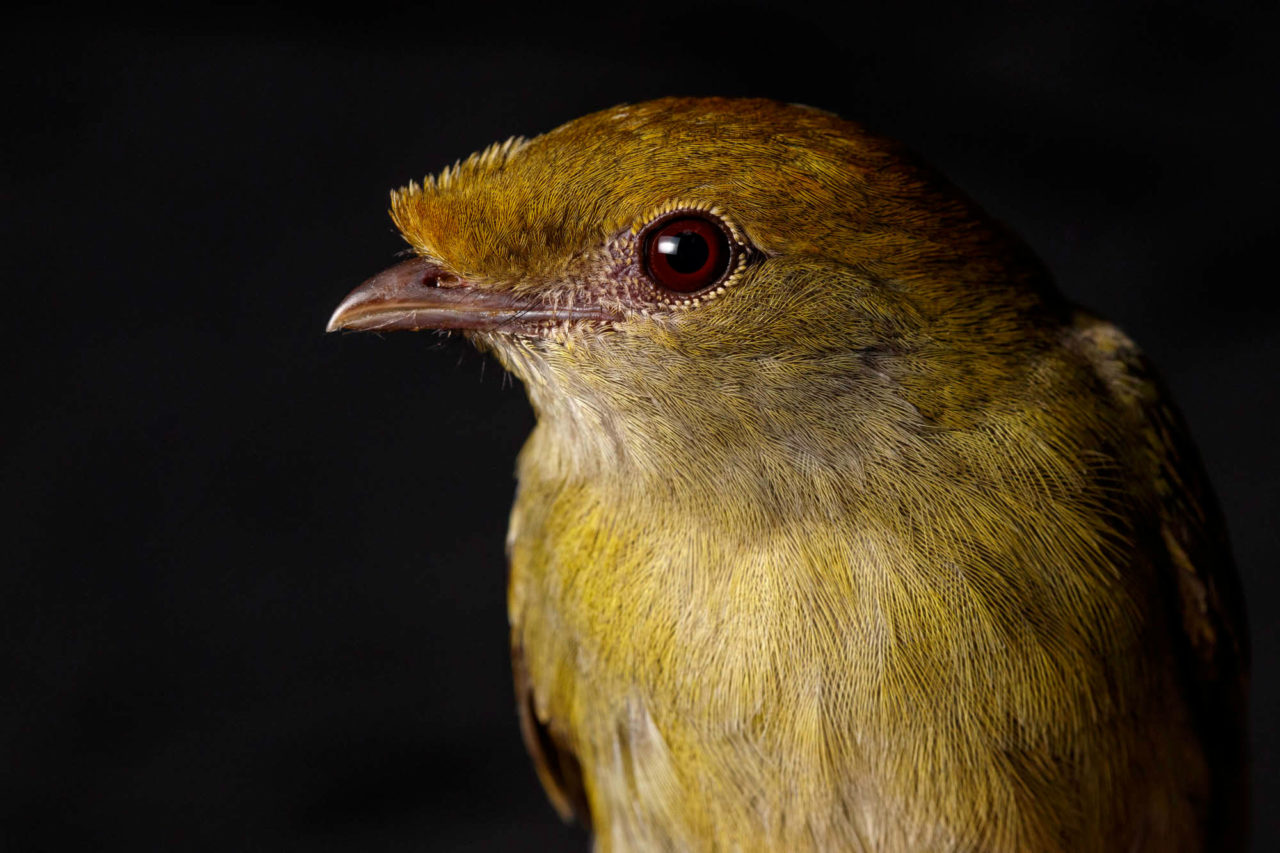
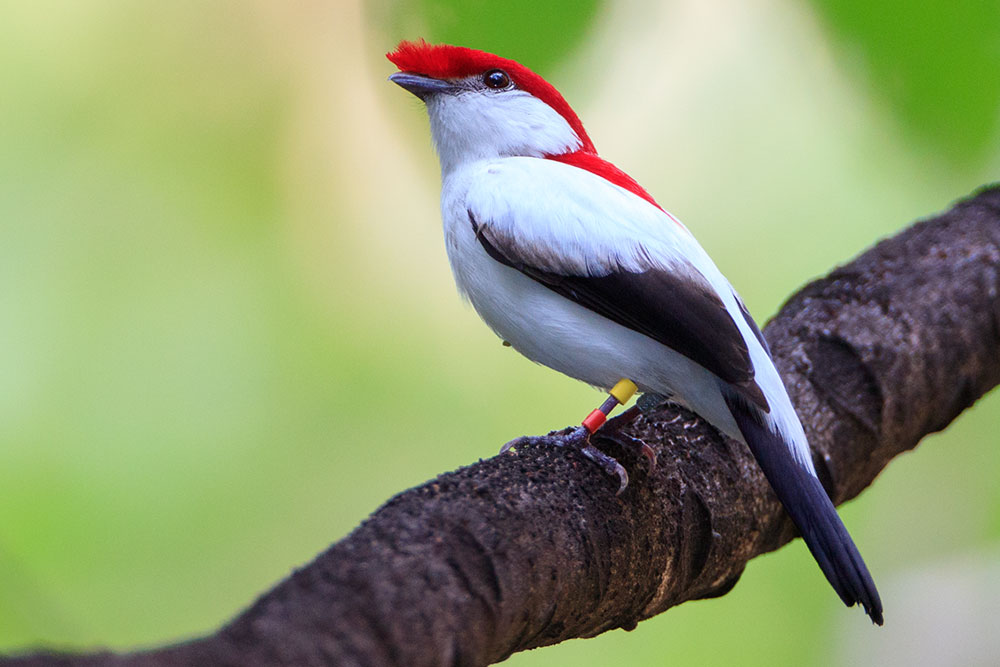
Another cheerful song burst from the trees, and a songbird’s silhouette flashed to a bare branch overhead. I glassed it through binoculars to see a bird cloaked in bright white plumage, with a dazzling crimson headdress—indeed clad in an officer’s regalia. The soldadinho looked left, then right, granting me a view of its profile and its blazing red pompadour. Looking at this brilliant bird is a bit like looking at the sun; red spots lingered in my eyes, emblazoned, for a few moments after the manakin flew away.
A gurgling brook flowed alongside the paver-stone path where I stood. About 500 feet upstream, there was a grotto that hid a spring, the source of water for this moist ecosystem, and this water park. Herein lies the conflict for soldadinho, the reason it’s an IUCN Red List critically endangered species. Both bird and people need this water: the manakins nest by the water and only live in wet forests; the people tap into the water for all their human endeavors—agriculture, urban growth, water parks.
But the manakin and the people here are not adversaries. In fact, the people celebrate the bird, and the bird may be the best hope for keeping the water flowing for the people.
A Fire-Crested Bird
Alberto Campos had his own luminous experience with the Araripe Manakin back in 2003, when he drove eight hours from the regional capital of Fortaleza to investigate reports of a new bird species discovered in the Chapada do Araripe, or Araripe plateau.“The first time I put my eyes on it … it shines, you know? That crest shines like a red bulb,” he recalls. “It’s an amazing, memorable experience.”
The first time I put my eyes on it … it shines, you know? That crest shines like a red bulb.
~ Alberto Campos
At that time, Campos was a biologist who had cofounded a conservation group called Aquasis on Brazil’s northeastern coast to help endangered marine animals such as dolphins and manatees. Now, a decade and a half later, Campos was taking me on a tour of his group’s on-the-ground conservation efforts for the Araripe Manakin, 300 miles away from the ocean. If it seems odd that a marine nonprofit would become the most ardent advocate for a forest songbird, the explanation lies in the species’ biology—because this bird relies on water every bit as much as a manatee.
“We have found nests not exactly on top of running water, but really, really close to it, right above,” says Campos. He says that along streams grown over with vegetation, the birds construct small nest cups among the vines and branches that dangle just above the stream’s surface.
And yet, this wet-forest manakin lives in the caatinga biome, a semiarid region about 7 degrees south of the equator. To be precise, the Araripe Manakin lives in a moist-forest oasis in the middle of a scrub-brush landscape, a topographical peculiarity that’s like a Hawaiian cloud forest dropped into the sagebrush country of Utah. The moisture comes courtesy of the chapada, an old Portuguese word for plateau. The tabletop of the chapada acts like a 4,000-square-mile rainwater catch basin. Whenever rain hits the ground on the plateau, it slowly percolates into the soil and collects into underground pools. The water then migrates sideways, reemerging as hundreds of natural springs on the plateau’s side to feed a humid forest habitat. It may take thousands of years for raindrops to funnel from the chapada’s dusty, scrub-brush top to the slopeside gushing founts amid gallery forests.
Text and images taken from Living Bird (read full article).
This is an example of a global CTA
Supporting Text for the global CTA